
If you’re publishing high-quality content but Google still seems to ignore you, you likely don’t have a writing problem. You have an urban planning problem.
Imagine building the world’s greatest library but forgetting to build hallways, signs, or doorways between the rooms. The books are there, but nobody can reach them. That is exactly what happens to 90% of the websites I audit: they are disconnected islands.
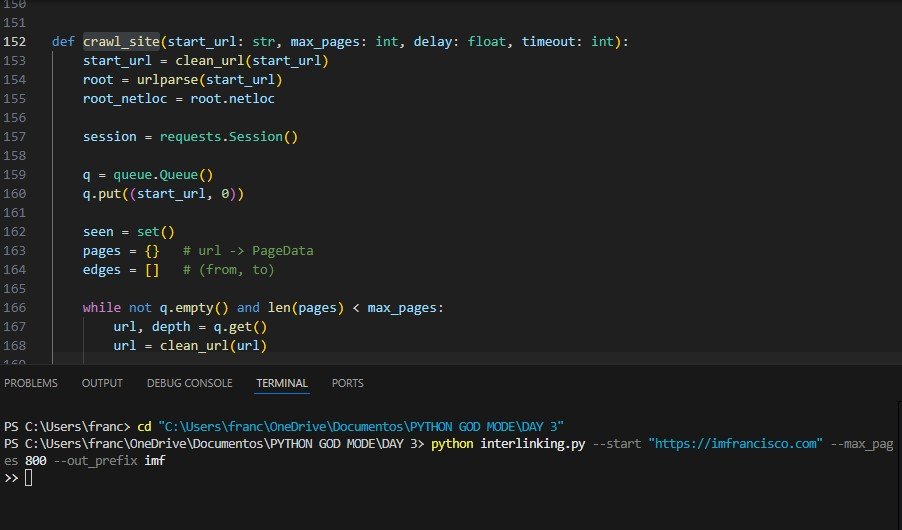
I don’t use AI to “guess” this. I use a custom Python script that crawls your website exactly like Google does, mathematically. Today, using real data from my own site (imfrancisco.com), I’m going to show you how to detect the invisible leaks draining your SEO budget.
1. The Law of Lineage: “If the Child Does Not Honor the Father, Strength Is Lost” (Original: imf_suggestions)
In SEO, the classic structure is: Home > Category > Article. The number one error I see is writing articles (“children”) that forget to pass authority back to their category (“father”).
Look at this snapshot from my audit:

The script detected a “Golden Opportunity” (Hub Score 51).
What is the data telling me? Look at the first few rows. It tells me I have articles about Copywriting (from_url) that contain zero links pointing back to the main Copywriting Services page (to_url).
- The Problem: The article gets traffic, but the sales page (the category) remains poor because its own children aren’t recommending it.
- The Wise Solution: The “child” (article) must honor the “father” (category).
- The Action: The script gives me a precise order: “Go to URL A and insert a link to URL B.” By doing this, you close the circuit of authority, and your money pages climb the rankings.
2. The Law of the Heart: “A Heart That Doesn’t Pump Kills the Body” (Original: imf_hubs)
The Homepage is the heart of your website. It receives the most external backlinks and authority. Its job is to pump that strength out to the extremities (your articles).
But look at what the script found on my site:
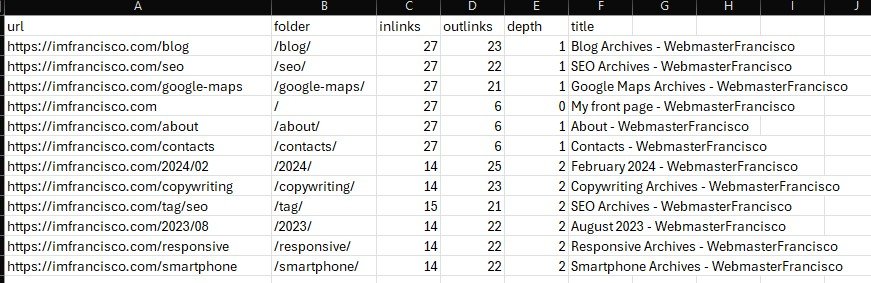
The Revealing Data (Row 4):
- My Home receives 27 inlinks (it has plenty of blood/strength).
- But it only has 6 outlinks.
What does this mean? It means my Homepage is a bottleneck. It is hoarding authority rather than distributing it. It is a heart that keeps the blood for itself.
- The Wise Solution: Stagnant wealth rots; circulating wealth grows.
- The Action: I need to open the floodgates. I must add direct links from the body of the Homepage to my top categories (SEO, Maps, Blog) so that strength flows downward.
3. The Law of the Tribe: “No One Survives Alone in the Jungle” (Original: imf_clusters)
Do you have sections of your website that feel like ghost towns? My script groups your site by topics (Clusters) and tells you which ones are abandoned.
Observe the comparison between folders:
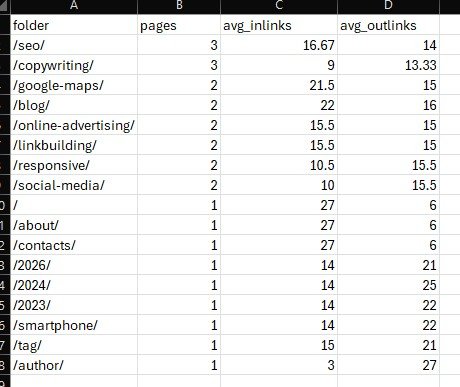
Look at the /copywriting/ folder:
- It has 3 pages (decent content).
- But its Average Inlinks is only 9.
- Compare that to the
/seo/section (first row) which has 16.
What does this mean? It means I am marginalizing my own Copywriting content. Google sees that the rest of the web isn’t talking about it, so it assumes it’s not important.
- The Wise Solution: If you want to be known for something, you have to talk about it constantly.
- The Action: I need to go to my popular SEO articles and mention (link to) my Copywriting articles. I need to integrate that “tribe” into the rest of the community.
4. The Law of Visibility: “You Can’t Win a Race If Your Shoelaces Are Tied” (Original: imf_issues)
This is the painful part. Sometimes, the problem isn’t a lack of links; it’s “technical suicide.”
Look at the Issues Report:
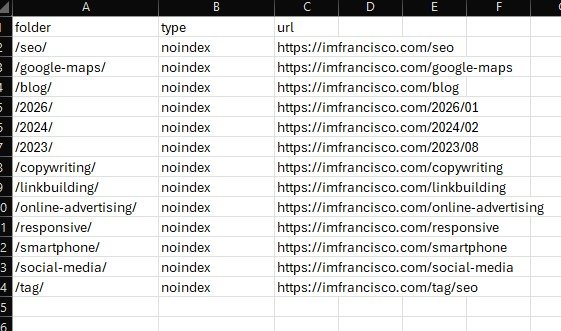
Do you see that column that says noindex repeated in every row? The script detected that all my main categories (/seo/, /blog/, /google-maps/) are tagged as NOINDEX.
The Disaster: I explicitly told Google: “Hey, don’t show my most important pages in search results.” It was likely a plugin configuration error, but it was costing me thousands of visits.
- The Wise Solution: Before you run, make sure the parking brake isn’t on.
- The Action: Change those settings to
INDEXimmediately. Without this script, I could have spent years writing content without knowing I had locked the front door.
5. The Law of Connection: “Roads Build Economies” (Original: imf_edges)
Finally, the script generates the real roadmap of your website. There are no opinions here, only routes.
This is the Connection Map:
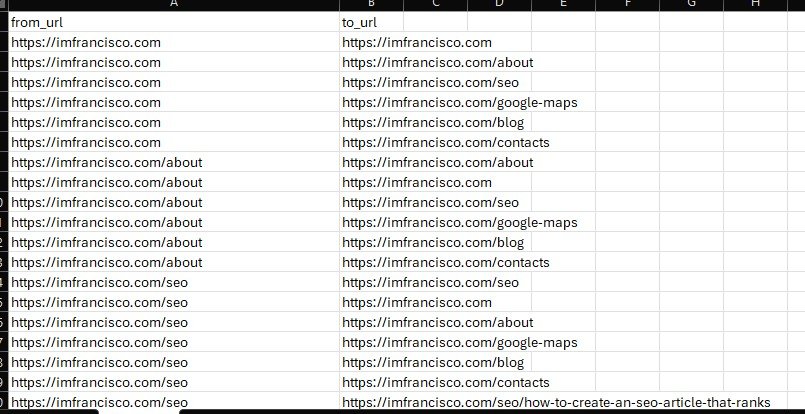
Here I saw that my SEO articles link to the category, and the category links to the articles… but the articles do not link to each other (there are no post to post rows).
If a user reads “How to do SEO,” they finish the post and leave. I’m not offering “How to do Keyword Research” as the next logical step. These are dead ends.
Next step: once your internal linking is fixed, improve clicks from Search by optimizing titles and meta descriptions using Google Search Console CTR optimization.
- The Wise Solution: Don’t build isolated silos; build neural networks.
- The Action: Create horizontal links. Ensure every post naturally recommends the next one.
6. The Law of Inventory: “What Gets Measured, Gets Managed” (Original: imf_pages)
To close, the script performs a full X-ray, URL by URL, to ensure there are no broken links or buried content.
Here is my full inventory:
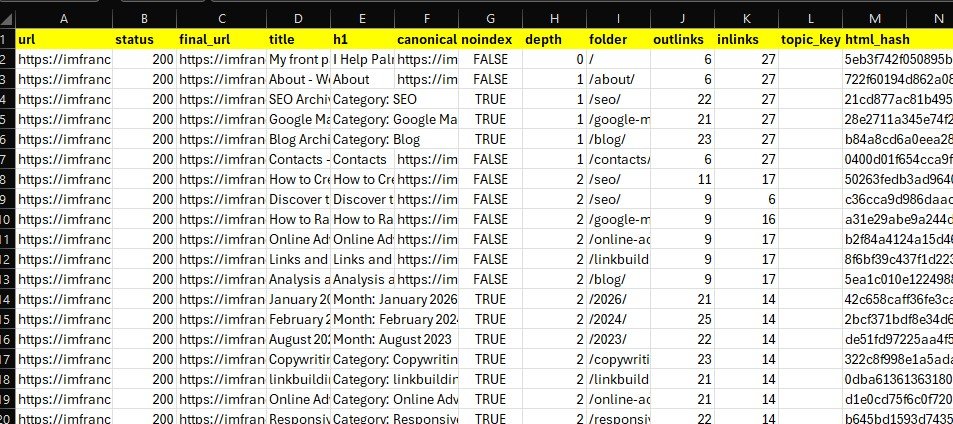
What I look for here: I check the depth column. Everything is at 1 or 2. That is excellent. If I saw numbers like 4 or 5, it would mean the content is buried in the website’s basement, where Google’s crawlers rarely visit.
- The Wise Solution: Keep your valuable assets near the surface.
- The Action: If I had deep URLs, I would link them from the Home page or Menu to elevate their status.
🐍 The Source Code: Python Interlinking Auditor
Don’t just trust the theory, test the logic. Below is the full, open-source Python script used in this case study. It includes the Jaccard similarity algorithm for detecting cannibalization and the ‘Hub’ scoring system. You can run it locally on your machine to generate your own CSV reports.
Your Website Needs an Architect, Not Just More Bricks
Continuing to write content on a poorly structured website is like adding more floors to a building with a crooked foundation. Eventually, it will stop growing.
This Python script has no opinions. It has no “creativity.” It has math. It crawls your site, calculates Link Juice, finds orphan pages, and tells you exactly where to build the bridges.
Do you want to see the real map of your business?
If you want a quick win after fixing site architecture, start here: Google Search Console CTR optimization.
You don’t need to know how to code. I run the script for you. Drop your URL and email below, and I will send you your custom Site Architecture Diagnosis containing:
- Your 3 “Black Sheep” (orphan or weak pages).
- Your Authority “Bottlenecks.”
- A list of 5 “Quick Win” links you should add today to boost your ranking.