

If you want to learn how to create an SEO article that ranks, this guide breaks down the real process step by step. There is a very common belief online: if you write well, your article will rank.
In reality, that idea is one of the main reasons most SEO articles never reach the first page of Google.
Why this guide is different: This is the same framework I use to audit search intent, SERP competition, content structure, CTR, and ranking drops, so you can write with a real advantage instead of guessing.
What you’ll get from this guide:
- A practical outline template you can reuse for any SEO article
- A final optimization checklist (title, meta, internal links, images, CTA)
- A simple mini example to model your process and avoid common mistakes
- How to Rank Faster on Google Using Pages You Already Have (2026)
- SEO in 2026 Strategy
If you want me to review your article or site, scroll to the form at the bottom.
The problem is rarely grammar, spelling, or even subject knowledge. The real issue is lack of strategy. Writing without understanding search intent, without analyzing real competitors, and without structuring content in a way Google can clearly interpret almost always leads to content that gets ignored.
An SEO article that ranks is not the result of inspiration. It is the result of a process, a process that combines analysis, judgment, structure, and a clear understanding of how Google decides what to show and what to filter out.
This is not a generic guide or a recycled list of SEO tips. In this article, I explain the real process for creating an SEO article with actual ranking potential, the same approach used when content is not just informational, but a strategic asset for a business, a service, or a personal brand.
If you want to understand why most articles fail, and how to do it right from the start, this is where it begins.
Why Most SEO Articles Fail to Rank
Most SEO articles don’t fail because of “bad writing,” but because of bad strategy. First, many target overly broad keywords that are nearly impossible to win, competing against sites with massive authority, good writing alone won’t overcome that. Second, they ignore search intent: the content tries to educate and sell at the same time, becomes unclear, and doesn’t fully satisfy what users (and Google) expect. Third, they publish content that adds nothing new, it mirrors the same angles and structure as the top results, with no differentiation and no clear reason for Google to choose it.
Bottom line: they don’t rank because they’re written as standalone pieces without upfront analysis or a clear goal. Effective SEO starts before the first word is written.
Before You Write: Define the Article’s Search Intent

Before you start writing, you need to decide what the user is actually trying to achieve with that search. If you don’t define intent, you’ll end up writing “a bit of everything”, explaining, comparing, selling, and teaching at the same time, and Google will see it as content that doesn’t clearly satisfy any single need.
Informational user: wants to learn or understand. They’re looking for a clear answer, simple explanations, and practical examples that remove confusion.
Examples: “what is SEO,” “how to write an SEO article,” “how Google works.”
Commercial user: already understands the basics and is evaluating options. They want proof, results, comparisons, rough pricing, clear benefits, and trust signals.
Examples: “SEO services for local businesses,” “best SEO agency,” “SEO consultant near me.”
Google prioritizes intent over length because it doesn’t reward long content by default, it rewards the page that delivers the best answer for that query. An 800-word article can outrank a 2,500-word one if it’s more focused, clearer, and more aligned with what the searcher wanted.
Simple examples:
- If the query is informational, your article should teach the process with clear steps and real examples.
- If the query is commercial, your article should build credibility with results, comparisons, mini case studies, and a direct CTA.
Defining intent first makes everything else, structure, tone, sections, and CTAs, work together toward ranking and conversion.
Step 1: Choose a Keyword You Can Actually Win

The first real filter for an SEO article isn’t the writing, it’s the keyword. If you pick an unwinnable keyword, you can write the best article in the world and still won’t rank, because you’ll be competing against giants with years of authority, hundreds of related pages, and thousands of backlinks.
That’s why you should avoid ultra-broad keywords. Terms like “SEO,” “marketing,” or “business” are too vague and mix multiple intents. Google typically reserves those head terms for major brands or long-established authoritative sites. On top of that, broad keywords don’t clearly reveal what the user wants, so the content often ends up trying to cover everything, and satisfying no one.
The smarter move is targeting intent-driven long-tail keywords: more specific phrases that show exactly what the searcher is trying to accomplish. They may have lower search volume, but they usually come with:
- lower real competition,
- higher click-through potential,
- and better conversion rates (because the user has a clear goal).
Practical example:
- ❌ “SEO” (too broad and extremely competitive)
- ✅ “how to create an SEO article that ranks” (clear intent, specific topic, and more realistic competition)
Simple rule: if your keyword doesn’t let you answer clearly what the user wants and why your page deserves to rank, it’s not a keyword you can realistically win yet.
Step 2: Analyze the Competition on Google (SERP)
Before you write a single line, you need to see what you’re actually competing against on Google. That means analyzing the SERP (the results that show up when you search your keyword). This is where real SEO separates from “writing blindly”: if you don’t understand what Google is rewarding for that query, you’ll write without direction.
When you review the top results, focus on three things:
- Content type: Is Google showing step-by-step guides, list posts, short articles, tutorials, service pages, or comparisons? If you publish a different format than what dominates the SERP, you usually start at a disadvantage.
- Depth: How complete is each result? This isn’t just about word count, it’s about coverage. Do they answer common questions, include examples, templates, visuals, clear sections, FAQs?
- Angle: What’s the positioning? Sometimes everyone covers “how to write SEO,” but one focuses on blogs, another on businesses, another on copywriting. That angle shapes what users expect.
Next comes the key part: spot real opportunities. Look for signals like:
- questions nobody answers well,
- sections that feel weak or too generic,
- lack of concrete examples,
- outdated content (no current year),
- titles that overpromise but underdeliver.
And here’s a core rule: don’t copy.
What you should NOT copy:
- the exact same structure from the top results,
- the same section order,
- the same generic angle,
- the same repeated subheadings.
Your goal isn’t to look like the #1 result, it’s to give Google a reason to say:
“This page is more useful / clearer / more complete for this intent.”
SERP analysis gives you leverage: you don’t guess what works, you observe it and improve it.
Step 3: Structure the Article for Google and the Reader
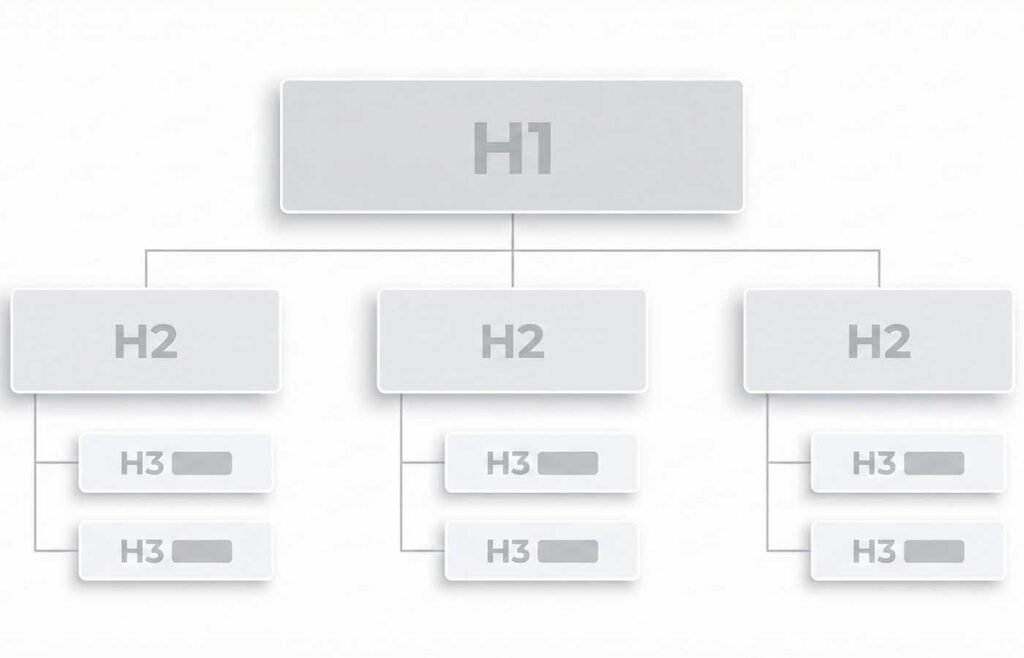
Once you have a winnable keyword and you understand the SERP, the next step is structure. This is where many people fail: they write “well,” but without a clear framework. An article that ranks must be easy to understand for two audiences at once: the reader and Google.
On-page structure starts with using headings correctly:
- H1: You should have only one H1, and it should clearly state the main topic (in WordPress, this is usually your post title).
- H2: These are your main sections that answer the big questions behind the search. Think of them as chapters.
- H3: These break an H2 into smaller, more specific parts without making the content feel heavy. They’re ideal for lists, sub-points, and mini-questions.
Next is scanability, which is now part of SEO. Most people don’t read word-for-word, they scan. If your content is a wall of text, engagement drops, and Google notices. To make it scannable:
- keep paragraphs short,
- use frequent subheadings,
- use bullets when they improve clarity,
- write direct, clean sentences.
The logical order of the content matters too. A strong article guides the reader like a conversation: first the “why,” then the “how,” then the actionable details, and finally a clear conclusion. When the flow is messy, users get lost and bounce.
Finally, focus on basic reading UX: the reader should understand the main point in seconds, find what they need quickly, and feel that the content is organized to help, not to fill space. When structure and clarity align, ranking becomes much easier.
Step 4: SEO Writing That Does Not Sound Like SEO
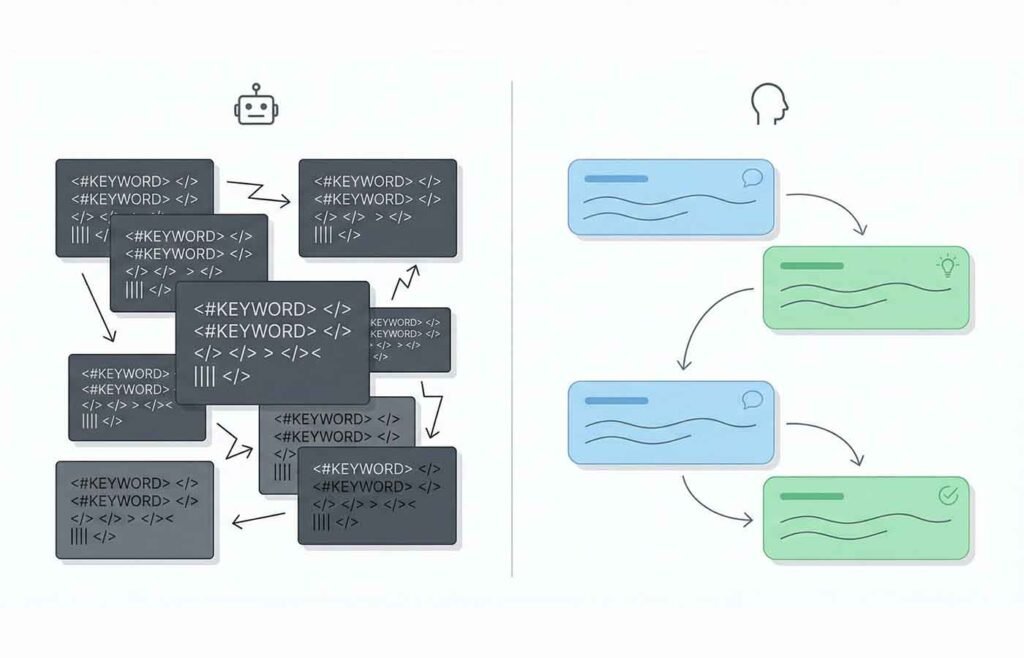
Once your structure is clear, the next goal is to make the article sound human. Most “SEO” content fails because it feels mechanical: it repeats the keyword, uses forced phrases, and reads like it was written for a robot. That does not just hurt perceived quality, it also reduces time on page and trust, and that can hurt performance.
The rule is simple: write naturally first, then optimize. If the content is clear and genuinely helpful, SEO can be added without overdoing it. Write as if you are explaining the topic to a real person: direct, practical, and easy to follow.
Instead of repeating the keyword over and over, use synonyms and natural variations that keep the meaning while expanding context. For example, if your topic is “SEO article,” you can rotate phrases like “optimized content,” “Google-focused post,” “article that ranks,” and “search-driven content.” This helps Google understand the topic without repetitive phrasing.
Avoid keyword stuffing, meaning forcing the keyword into sentences where it does not belong. Readers notice it quickly, it feels unnatural, and it often hurts credibility. A better approach is to place the keyword in strategic spots: the H1, a few H2s, the first paragraph, and naturally throughout the body.
Finally, use human language, not unnecessary technical jargon. You do not need to sound like an engineering manual to prove you know SEO. Real expertise shows when you can explain something clearly and simply. That mix of clarity and precision is what separates strong SEO writing from generic content.
Step 5: Final Optimization Before Publishing
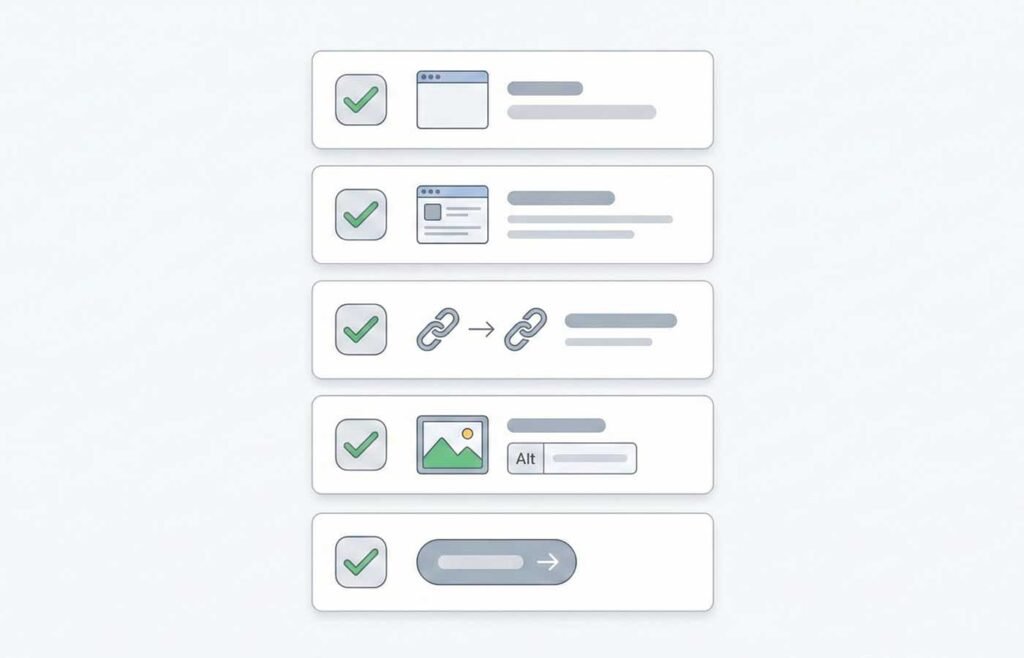
Before you publish, an SEO article needs a final optimization layer. It is not the most exciting part, but it is where professional quality shows up. Small adjustments can improve click-through rate, help Google understand the page, and make the reading experience smoother without turning the content into something overly technical.
Start with the SEO title. It does not have to match the H1 exactly. Its job is to earn the click in search results. A strong SEO title is clear, benefit-driven, and when relevant, includes a specific angle like “step-by-step,” “real methodology,” or the current year.
Next is the meta description. It does not directly boost rankings, but it can improve clicks. It should summarize the value of the article in one or two sentences and end with a subtle invitation, such as “see the full process” or “apply this method.”
Then focus on internal linking. A standalone article is weaker. Linking to 2 to 4 relevant pages on your site helps Google understand your content ecosystem, distributes authority, and increases time on site. The key is that every link must be contextual and useful, not filler.
After that, optimize images and alt text. Images improve engagement and make explanations easier to follow. Use quality visuals, appropriate sizing, and descriptive alt text that explains what the image shows. If it fits naturally, include a keyword variation, but avoid spammy alt text.
- If you already have published posts, use this method to rank faster with existing pages.
- If you want the complete picture, here is my 2026 SEO strategy to prioritize what moves the needle.
Common Mistakes That Prevent an Article From Ranking
Many articles do not fail because of “technical SEO,” but because of basic decisions that reduce their value from day one. The first mistake is writing for Google instead of for people. That usually creates stiff, keyword-heavy text with low clarity. If readers do not understand your point quickly, they leave, and Google notices those engagement signals.
The second mistake is copying structures without thinking. Looking at the top results and replicating the same section order, the same subheadings, and the same generic angle produces more of the same. That gives Google no reason to choose your page over what already ranks.
The third mistake is publishing without a strategy. An isolated article with no internal links, no clear goal, and no connection to related content is usually weaker. SEO performs best when each piece fits into a system: clear intent, smart internal linking, and a consistent next step for the reader.
Finally, the most common mistake is not measuring results. Without data, you cannot tell whether the article is growing, stagnating, or missing easy wins.

Benefits of Using Google Analytics 4 (GA4)
GA4 shows what happens after the click. It helps you understand whether the article truly holds attention: how long people stay, what pages they visit next, and whether they take meaningful actions like clicking a button, opening a contact form, or starting a WhatsApp chat. This helps you improve user experience and turn content into an asset that generates leads, not just traffic.
Benefits of Using Google Search Console (GSC)
GSC shows what happens before the click: impressions, average position, and click-through rate. It is the key tool for finding fast opportunities, like queries where you are already ranking in positions 5 to 15 and only need a stronger section, a few targeted FAQs, or a better title and meta description. With GSC, you stop guessing and start optimizing with precision.
How This Process Applies to Real Businesses
This process is not just about “ranking for the sake of ranking.” In real businesses, a well-built SEO article can generate revenue because it works 24/7: it attracts intent-driven traffic, filters the right audience, and warms up the conversation before someone ever contacts you.
A strong article works as a sales tool because it answers the questions clients always have before buying: what the service includes, what results to expect, what mistakes to avoid, and what a professional process looks like. When a potential client reaches your website after reading something like this, they arrive with more trust and fewer objections. In other words, the content helps sell for you.
Unlike an ad that stops working the moment you stop paying, an article can keep bringing visits for months or even years if you optimize and refresh it. With small improvements like updating the title, strengthening sections, adding FAQs, and improving internal links, you can increase performance without starting from scratch.
For service businesses and local companies, this becomes even more practical. You can publish articles that target real needs such as “SEO for [city],” “how to show up in Google Maps,” “why calls are not coming in,” or “how to improve reviews.” That kind of content attracts people with specific problems, and you naturally show up as the logical solution. That is where SEO stops being theory and turns into sales.
Closing: From Content to Results
Writing an SEO article is not about filling a page with text or repeating keywords. What actually ranks is a clear process: choosing a keyword you can realistically win, understanding what the searcher wants, analyzing the SERP, structuring the content for fast reading, writing naturally, and finishing with final optimizations that improve clicks and trust.
The difference between theoretical SEO and practical SEO is simple. Theoretical SEO sounds good, but it does not move the needle. Practical SEO is measurable, improvable, and designed to attract visitors with real intent.
If you want, you can use this article as a template for your next pieces of content. And if you would rather have me apply this approach directly to your website or local business to improve visibility and leads, you can reach out in whatever way is easiest: fill out the form below, send me a message, or use any contact option on this page, and we will review it.
If you’ve read this guide and you want faster results, here are two clear next steps:
- If you already have published content and you want to rank faster using the pages you already own, read this method.
- If you want the full picture of what is working right now and what to prioritize this year, read my SEO in 2026 strategy.